
Introduction
Brothers and sisters, greetings in the wonderful name of our Lord Jesus Christ. This message continues the series on The Throne of God, and this second part carries the title “A Tabernacle That I May Dwell Among Them.”
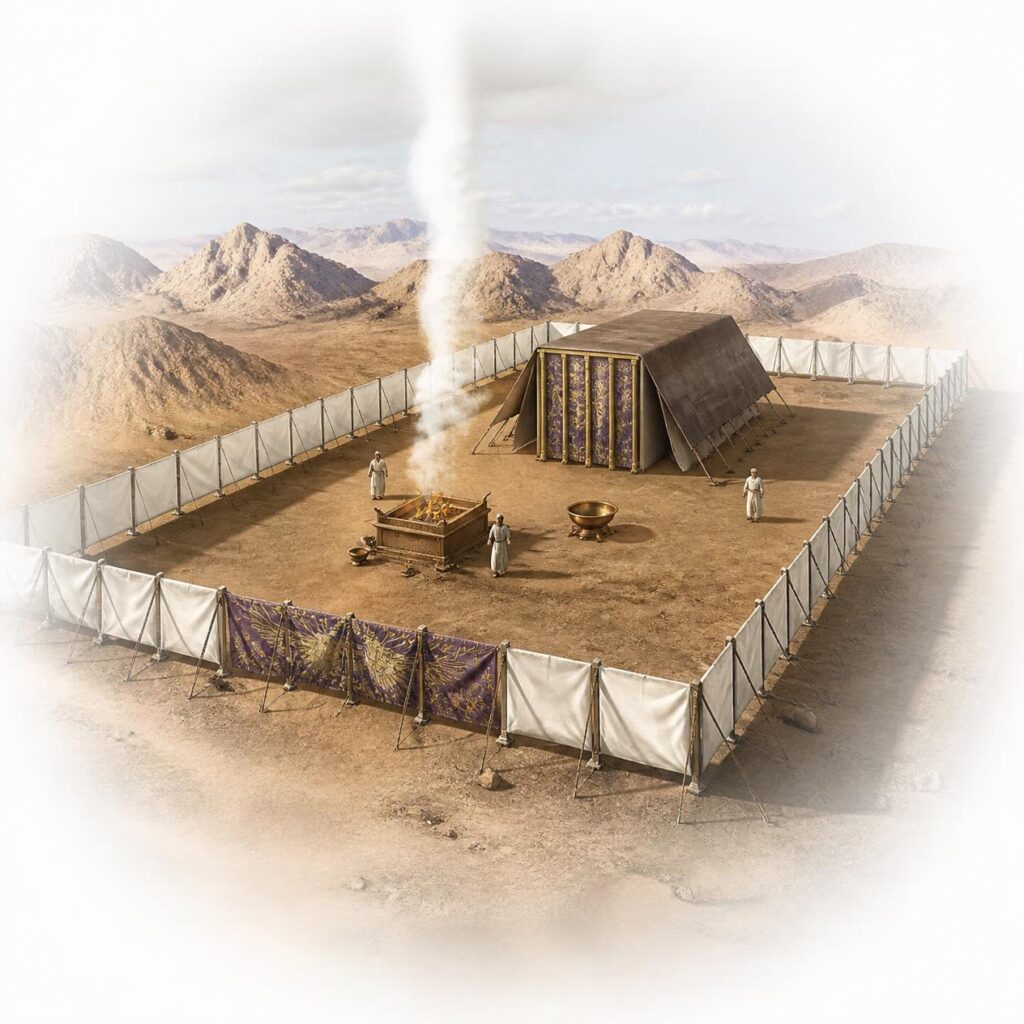
The foundation of this study is Exodus 25:1-9. This passage is simple and easy to follow, yet it is vitally important when we look at our own lives and consider God’s reasons for the building and makeup of the Tabernacle of Moses.
Before Moses, no man had ever seen or perceived the throne of God, nor was there any record of God sitting upon a throne resembling those built by earthly kings. Visions of thrones came later — in Isaiah, Ezekiel, and eventually the Book of Revelation. But prior to all of that, the only semblance of a throne was seen in the wilderness, in the Tabernacle of Moses — also called the Tabernacle of the Testimony.
This series will take the Tabernacle piece by piece, room by room, and piece of furniture by piece of furniture, understanding every attribute that made it up. To do that, we must first understand what God asked the people to do, beginning with Exodus 25:1-9. In this section of Scripture — nine verses — eleven key phrases are drawn out and studied point by point.
Exodus 25:1-9 (KJV)
1 And the LORD spake unto Moses, saying, 2 Speak unto the children of Israel, that they bring me an offering: of every man that giveth it willingly with his heart ye shall take my offering. 3 And this is the offering which ye shall take of them; gold, and silver, and brass, 4 And blue, and purple, and scarlet, and fine linen, and goats’ hair, 5 And rams’ skins dyed red, and badgers’ skins, and shittim wood, 6 Oil for the light, spices for anointing oil, and for sweet incense, 7 Onyx stones, and stones to be set in the ephod, and in the breastplate. 8 And let them make me a sanctuary; that I may dwell among them. 9 According to all that I shew thee, after the pattern of the tabernacle, and the pattern of all the instruments thereof, even so shall ye make it.
From this passage, eleven points emerge for study:
- Bring me an offering
- Let every man give it willingly with his heart
- Gold, and silver, and brass
- Blue, purple, scarlet, fine linen, goats’ hair, rams’ skins dyed red, badgers’ skins, shittim wood
- Oil for the light
- Spices for anointing oil and sweet incense
- Onyx stones and stones for the ephod and breastplate
- Make me a sanctuary
- According to all that I shew thee
- Follow the pattern of everything
- That I may dwell among them
To build this Tabernacle in the wilderness, roughly two million people traveling through desert terrain had to bring in materials from what they already possessed with them — there was little to gather from the ground around them. The Tabernacle had to be built entirely from whatever the people carried on that journey. This first requirement — that the materials themselves had to be an offering — is point number one.
Point One: Bring Me an Offering
To begin building the Tabernacle, the people had to collect the materials themselves. Consider this: God could easily have raised up a tabernacle by His spoken word — the same way He created the earth by faith — so that everyone would immediately recognize it as the work of God Himself. He could have spoken into existence the most flashy, beautiful tabernacle imaginable, built of the finest materials, and the world would have known instantly that no man had built it.
But He chose not to do that.
Instead, He chose to build His dwelling place from the belongings of men — slaves, sinners, wanderers. It was not something they could go out and gather or hew from the earth; it had to be something they already owned, something given up as an offering.
There are several reasons for this:
First, if God had built the Tabernacle Himself out of nothing, man would have turned it into an idol, just as he has done with everything else God has created.
Second, by having the people build it from their own belongings, God could remain hidden in simplicity — unnoticed by the world, underestimated by it — so that He could deal with His children in secret. God wants to be noticed by His elect, those who are truly searching for Him from their hearts.
Third, requiring a sacrifice from the believer allowed God to see the hearts and intents of the givers, and to demonstrate His ability to sanctify what man offered.
Point Two: Let Every Man Give It Willingly With His Heart
The offering had to be given willingly. As with any offering brought to God, if it is not given willingly, it becomes a curse rather than a blessing.
If the offering was given grudgingly or with reserve, it would not be accepted, and the Tabernacle would not have been perfect. A tabernacle built by people who feel entitled — as though God owes them something for years of service, for souls brought in, or for offerings given — is not a tabernacle His Spirit would abide in.
The offering could only be sanctified if the believer gave in faith, believing that in giving he was losing nothing and gaining everything. This is the same mindset required when we give our all to Christ — our bodies, spirits, souls, families, and loved ones — believing we lose nothing and gain everything. This was the test of the intent of the heart, the most important test to God.
Moses had to receive every piece of material personally, look into the eyes of each giver, and rely on discernment given by God to know whether the gift was given freely. Even a single piece of leather handed over grudgingly would have to be refused. When an offering was given grudgingly to Moses, he would have said this: “I cannot accept something for the Tabernacle of the Most High that was given grudgingly or with reserve.”
God also asked for the people’s most precious belongings — not their cast-offs. Why? It is far easier to give away things we no longer value than to part with what we treasure most. God does not consider gold and silver themselves to be precious — He knows that men do. He knew men prized these metals, so He asked them to bring what they themselves considered most valuable, as the truest test of the heart.
The more valuable the materials given, the more the people would respect the finished Tabernacle. This process also weeded out thieves in the camp — those who lusted after the Tabernacle’s riches. And once everything was surrendered, all the people became equal in each other’s eyes, because the Lord alone held the wealth. There was no rich and no poor among them — all were equal.
Point Three: Precious Metals — Gold, Silver, and Brass
Gold, silver, and brass allowed a man to define himself — and be defined by others — in society. A man adorned in gold and silver was seen as wealthy and of high standing. A man clad in brass armor was seen as a soldier, a general, one of respect. These metals served no purpose but vanity.
Walking through the wilderness with no goods to buy, and no one to trade with, there was no reason to keep gold or silver — to do so was nothing but lust and vanity. Brass, a hard and durable metal useful for weapons and armor, was likewise unnecessary, since the Lord Himself — the pillar of fire — fought for His people. They had no need of armor, no need of precious metals, no need of any of it. Yet they possessed these things, having taken the spoils of Egypt.
These metals symbolized wealth and status. Surrendering them all to the Lord willingly caused the believer to overcome the pride that so easily attaches itself to such possessions.
Point Four: Precious Cloths and Materials
The precious cloths named in Exodus 25 — blue, purple, scarlet, fine linen, goats’ hair, rams’ skins dyed red, badgers’ skins, and shittim wood — were, apart from the wood, all cloths. Walking through the wilderness, there was no practical need for purple, scarlet, or fine linen; clothing oneself in such fabric amounted to nothing but vanity and pride.
Yet these same materials were then taken and used for the clothing of the priests and the furnishing of the Tabernacle. God removed the ability to dress vainly from the individual believer, but repurposed those same materials for His dwelling place. And when the people later entered the Promised Land, God was emphatic that they were not to take gold, silver, or anything from the inhabitants of that land for themselves.
Deuteronomy 7:25-26 (KJV)
25 The graven images of their gods shall ye burn with fire: thou shalt not desire the silver or gold that is on them, nor take it unto thee, lest thou be snared therein: for it is an abomination to the LORD thy God. 26 Neither shalt thou bring an abomination into thine house, lest thou be a cursed thing like it: but thou shalt utterly detest it, and thou shalt utterly abhor it; for it is a cursed thing.
Joshua 6:17-19 (KJV)
17 And the city shall be accursed, even it, and all that are therein, to the LORD: only Rahab the harlot shall live, she and all that are with her in the house, because she hid the messengers that we sent. 18 And ye, in any wise keep yourselves from the accursed thing, lest ye make yourselves accursed, when ye take of the accursed thing, and make the camp of Israel a curse, and trouble it. 19 But all the silver, and gold, and vessels of brass and iron, are consecrated unto the LORD: they shall come into the treasury of the LORD.
Notice that God calls these things “the accursed thing,” and yet permits them to be brought into the treasury of the Tabernacle. History shows the institutional Church has, at times, used passages like this to justify plundering the people — enriching itself and its leaders at the expense of the flock. But God’s purpose was never the enrichment of an institution; it was to protect the people from idol worship — and from something even deeper: the corruption of the heart through lust for worldly things. Most assume this was only about the images of heathen gods, but the account of Achan reveals it was about more than idolatry alone.
Joshua 7:1 (KJV)
1 But the children of Israel committed a trespass in the accursed thing: for Achan, the son of Carmi, the son of Zabdi, the son of Zerah, of the tribe of Judah, took of the accursed thing: and the anger of the LORD was kindled against the children of Israel.
Joshua 7:22-24 (KJV)
22 So Joshua sent messengers, and they ran unto the tent; and, behold, it was hid in his tent, and the silver under it. 23 And they took them out of the midst of the tent, and brought them unto Joshua, and unto all the children of Israel, and laid them out before the LORD. 24 And Joshua, and all Israel with him, took Achan the son of Zerah, and the silver, and the garment, and the wedge of gold, and his sons, and his daughters, and his oxen, and his asses, and his sheep, and his tent, and all that he had: and they brought them unto the valley of Achor.
Notice what Achan took — not idols, but silver and gold. He may well have loved God and been dedicated to his people, but he failed because he lusted after worldly goods. What God was protecting the people from was the very desire to lust after worldly things. Whatever gold, silver, or precious material came into the camp was to be collected and brought to the Tabernacle, becoming the Lord’s. We can not become the Tabernacle of God when our hearts are full of lust for worldly things and prioritizing them over the Word of God.
Point Five: Oil for Light
Oil was central to worship in Scripture, and it is well understood as a type of the Holy Ghost. But why did the people themselves have to acquire this oil for the Tabernacle? Why not make it the priests’ responsibility, since they were the ones who maintained the Tabernacle? Why did God not simply supply the oil Himself — as He caused the widow of Zarephath’s oil to sustain her household for three and a half years?
It seems God intended the people to sustain the Tabernacle by their own continual effort. The construction, preparation, and maintenance of the Tabernacle required constant sacrifice. Light was necessary in the inner court, since no natural light entered there. The underlying principle running through every one of these points is sacrifice. To be the Tabernacle of God — the throne of God — requires constant sacrifice. God does not produce the oil; we must bring it, again and again, as a continual offering.
Point Six: Oil and Spices for Anointing and Sweet Incense
God was concerned even with fragrance. The spices were used to prepare the anointing oil for the priesthood — an oil or perfume poured out upon those set apart for service. This instruction was later misused by segments of the Church to enrich the priesthood or elevate its importance above the people, but that was never its true purpose. God did not ask the children of Israel to bring oil and spices because the priesthood had to become rich or wealthy. Just like we have said previously, the underlying principle running through every one of these points is sacrifice – God teaching the children of Israel to prioritize Him before anything else. He was preventing them from being corrupted by worthless things.
The people had to give up their most beautiful spices and fragrances for the priesthood’s use. No one else was permitted to imitate the scent of the priesthood — to do so cost a man his life. The priests had to smell distinctly different from the rest of the congregation. Spices were rare and difficult to obtain, requiring skilled craftsmanship — the ancient equivalent of a chemist. Obtaining them often meant trading with strangers or merchants along the journey, giving up something valuable in order to secure something rare, and then presenting it as a freewill offering to the Lord. No one was permitted to be, or to smell, better than the Tabernacle itself.
Point Seven: Precious Stones for the Ephod and Breastplate
Beyond gold, silver, precious cloth, oils, and spices, the people also had to surrender precious stones for the ephod and breastplate of the high priest. This was never meant to enrich the high priest personally, but to create a clear distinction between him and the other Levites, since he alone served as intercessor of the atonement. No one else was permitted to wear garments resembling his — doing so was punishable by death.
Does God love diamonds, jasper, sardius, topaz, onyx, and carbuncle? No. These stones are precious to men only because of sin — they are, after all, simply rocks cut and polished to catch the light. Yet because men had already begun mining and prizing these stones, God said, in effect, “Bring them in. Make them Mine.” His purpose, again, was to prevent the people from corrupting themselves through lust for wealth, pride, and worldly status.
Point Eight: Make Me a Sanctuary
“Make me a sanctuary” is a remarkable statement. God was never going to build a sanctuary for Himself out of necessity — as Stephen declared, no house built by human hands could ever be sufficient for the Lord. Everything the people could possibly bring would still fall short of building an adequate dwelling place for God.
And yet, in the wilderness, God asked for these simple things — gold and silver, yes, but not in overwhelming quantity — and from them a crude little Tabernacle was raised, becoming the temple of the Lord Most High. God ordered the people to build it themselves, though He could easily have done it Himself, because the entire process was a test of faith and humility. He had them gather every material and then instructed them to design, assemble, and rebuild it — over and over, every time the camp moved — always exactly according to the pattern.
Point Nine: According to All That I Shew Thee
The word “shew” (show) in Scripture means to reveal. This tells us two things: first, that the Tabernacle had to be built by revelation; second, that this revelation could come only from God Himself.
Remember Peter’s confession in Matthew’s Gospel:
Matthew 16:17-18 (KJV)
17 And Jesus answered and said unto him, Blessed art thou, Simon Bar-jona: for flesh and blood hath not revealed it unto thee, but my Father which is in heaven. 18 And I say also unto thee, That thou art Peter, and upon this rock I will build my church; and the gates of hell shall not prevail against it.
God was telling the people, in effect: “Make me a sanctuary according to what I reveal to you — not your own idea, though it will be built by your hands and your sacrifice.” Moses did not see a grand vision of heaven with angels and a throne and then simply copy what he saw. God gave him a vision, and Moses had the capacity to interpret that vision and apply it to what was actually available to him in his own time. It was built entirely according to the specifications of revelation.
Point Ten: Follow the Pattern of Everything
The people had to have faith to build according to revelation every single time the Tabernacle was disassembled and reassembled — not leaning on their own understanding. Had they built it according to their own design, pride would have crept in — as it does in churches today, where plaques commemorate founders, co-founders, and designers, and glory is given to a man rather than to God.
No one could claim credit for the Tabernacle’s design. Even though every material came from the people’s own offerings, the pattern itself was entirely God-given — unlike anything any man would have devised on his own. It required revelation and faith.
Point Eleven: That I May Dwell Among Them
This brings us to the title of the message: that I may dwell among them. God’s entire purpose was to dwell among His people. He did not need any of these precious materials for Himself — every requirement was designed to eliminate pride from the sanctuary and from the hearts of those building it.
This is why God called David “a man after his own heart” — not because David never sinned, but because he loved the Lord more than he loved himself. When David realized the Tabernacle of the Lord was housed more humbly than his own palace, he was deeply moved: “How could the king live in this, and the Lord live in that?” Yet God did not permit David to build Him a house, because God does not require earthly splendor.
When God came to dwell among us as Emmanuel, He came in a body without splendor — a body many did not even recognize as noteworthy, since others of that day appeared wealthier, better-looking, better-smelling, and of more prominent lineage. Everything about Christ appeared unattractive next to men like Caiaphas the high priest, Herod the Great, Barabbas, the scribes, Pharisees, Sadducees, and even the publicans. He was born into the family of a carpenter.
Isaiah 53:2-3 (KJV)
2 For he shall grow up before him as a tender plant, and as a root out of a dry ground: he hath no form nor comeliness; and when we shall see him, there is no beauty that we should desire him. 3 He is despised and rejected of men; a man of sorrows, and acquainted with grief: and we hid as it were our faces from him; he was despised, and we esteemed him not.
When this Tabernacle of God stood upon the earth in the person of Christ, the carnal men around Him were not looking for gold, silver, or anointing oil — they were judging only by outward appearance. Because He was not dressed as a high priest, they may have granted Him the respect due a rabbi, but they were disappointed by His appearance, His conduct, and the company He kept among ordinary people.
Because the people had no humility — because pride, wealth, and the pleasures of life had blinded them — they took this great Tabernacle, this body in whom God dwelt, and crucified Him. They whipped Him, scourged Him, mocked Him, spat on Him, plucked out His beard, pierced His side, and made Him carry His own cross like a slave.
Yet notice who did recognize Him: those who esteemed themselves lower — blind Bartimaeus, the woman at the well, the woman with the issue of blood, Zacchaeus the tax collector. Even Nathanael, who initially doubted, asking:
John 1:46-47 (KJV)
46 And Nathanael said unto him, Can there any good thing come out of Nazareth? Philip saith unto him, Come and see. 47 Jesus saw Nathanael coming to him, and saith of him, Behold an Israelite indeed, in whom is no guile!
All those who recognized Christ were people of humble character, free from pride and vanity.
What Does This Mean for Us Today?
What precious things does God require of us now? What is our gold, our silver, our brass? What is our precious cloth, our precious stones, our blue and purple and scarlet? What is our oil for light, our spices for anointing, our sweet-smelling savor? What sacrifices must we make to become part of His great throne?
The recent coronavirus lockdown proved that being the Tabernacle of God is not about a building, a congregation gathering with pews and organs, fine clothing, and fancy suits. It is not about keeping a message church. It is about the sacrifices we are willing to make — the offering of our lives — so that He may dwell among us.
Looking Ahead in This Series
This series will go on to examine, room by room and piece by piece:
- The Most Holy Place
- The Ark of the Testimony and the golden pot within it
- The Mercy Seat
- The Veil
- The Altar of Incense, made of wood overlaid with gold
- The Table of Shewbread and the bread upon it
- The Seven Golden Candlesticks, the oil within them, and the light that was never to go out
- The Brazen Laver, the vessel of water for cleansing and sanctification
- The Brazen Altar
- The curtains, skins, and knops forming the Outer Court, and every specification and sacrifice involved in their making
Each of these will be studied to ask: What must we bring? What must we lay down? What must we build, and according to what pattern and revelation?
Closing Thought
Do we truly believe we are the temple of the Holy Ghost simply because we attend church, pay tithes, speak in tongues, or prophesy? Is that the pattern — the revelation required for this day? Have we produced a tabernacle so precious that we have given our all so that He may dwell among us?
God’s purpose from before the foundation of the world was, and remains, to dwell in His sons and daughters, bringing full redemption to completion in a people who have chosen the way of truth. That will be the Tabernacle of the Most High God.
The Lord bless you, saints. Until the next time — search your hearts, your souls, your minds, your intentions. Look at your family, your home, your church, your community, your decisions. All of these things have to do with the sacrifice we say we make, that He may dwell among us.