
Introduction
Greetings, brothers and sisters, in the wonderful name of our Lord and Savior, Jesus Christ. It is good once again to share the Word of God, and what He has prepared for us in these last days.
Today we begin a new series called The Mark of the Beast. The sub-series is titled The Trail of the Serpent, and this first part is called The Beast in the Beginning, with the topic Identifying the Beast.
Why call it “the mark of the beast”? Because that is what we need to identify in the end times. Why “the trail of the serpent”? Because we must trace the beast all the way from the beginning in the Old Testament, through the New Testament, through the church ages, until we reach the beast of the end time.
Our scripture reading comes from Revelation chapter 13:
Revelation 13:16-18 (KJV)
16 And he causeth all, both small and great, rich and poor, free and bond, to receive a mark in their right hand, or in their foreheads:
17 And that no man might buy or sell, save he that had the mark, or the name of the beast, or the number of his name.
18 Here is wisdom. Let him that hath understanding count the number of the beast: for it is the number of a man; and his number is Six hundred threescore and six.
A Subject That Has Confused the Church for Centuries
The mark of the beast is a topic that has troubled Christians ever since the Apostle John first wrote these words on the island of Patmos, where he was a prisoner. It was there that John received the visions recorded in the Book of Revelation. Nobody knows exactly what he saw. But over the centuries, people have guessed, made doctrines, written stories, and even made Hollywood movies from it — earning billions of dollars in the process.

Sadly, the Christian church itself has often misused this topic. History records terrible and deceitful things done in the name of “the mark of the beast” and “666,” used to frighten people into staying loyal to their churches, and even used to demonize whole races and cultures.
For example, in earlier centuries some believed the mark of the beast was a literal mark on the skin. When white settlers first encountered black-skinned people, some wrongly believed that black skin itself was the mark of the beast. At other times, some Christian groups claimed that Saddam Hussein and radical Islamic nations were “the beast.” Many innocent people and even personal friendships have been hurt because of these false understandings, and in smaller ways this confusion continues today.
Forty years ago, this teaching was widely spread through flyers and gospel tracts, often carrying the words “666,” “the truth about the Antichrist,” and the Latin phrase Vicarius Filii Dei printed boldly at the bottom. People shared these with great excitement, believing they were bringing shocking new revelation to the world — that the Pope was the Antichrist who would unite the world, crush every system, and persecute the righteous. What most people did not realize was that the idea of the Pope being the Antichrist was not new at all — it has been taught in different Christian circles for hundreds of years, including by some Seventh-day Adventists, Jehovah’s Witnesses, and many other Protestant groups, each convinced that their own doctrine proved that Roman Catholicism was the enemy and that they themselves were the true believers.
Eventually, when this subject reached America, fiction writers and Hollywood realized what a “goldmine” the Book of Revelation could be. They turned the mark of the beast into pure fantasy: demons, fallen angels, scary children in horror films, microchips, and computers taking over the world. Every year brings a new scary movie, novel, or story, and billions of dollars are made — even by people who do not personally believe any of it, yet who are clearly fascinated by the spiritual and paranormal.
Because of this endless exaggeration, people have grown tired of the subject. Preaching “666” on a street corner no longer shocks anyone; people simply walk past, unimpressed. In more recent times, some believers even claimed that the COVID-19 vaccine itself was the mark of the beast. While parts of that story may resemble something spoken of in Revelation, it is nowhere near what the real mark of the beast is.
The result of all this confusion is that nobody really knows the truth anymore about this subject — except that, through the unfolding or opening of the Seven Seals that sealed the Book, believers today can clearly discern the enemy’s true nature and see his moves. Glory to God.
Two Important Diagrams
Before we go further, it helps to picture two diagrams.
Diagram One: A Man, a Beast, and a Woman

Look at the above diagram representing a man, a beast, and a woman. Two arrows point from the man and from the beast toward the woman — this shows that two different “seeds” were implanted into the woman. From the woman come two lines moving outward, showing two separate lineages: one being the line of man (through Seth), and the other being the line of the serpent (through Cain). Because these two bloodlines lived side by side and eventually mixed, the seed of the serpent lives in mankind today, though it can no longer be told apart by looks alone. That’s why the mark of the beast is really a spiritual mark that must be discerned, not a physical one.
Notice, too, in the diagram that there is another line coming from the beast and this line shows that the seed of the serpent stopped after the curse. Why? Because when the serpent’s form was changed by the curse, there was no more procreation or bloodline of the original beast as it had existed in the Garden of Eden. That creation was permanently changed.
This is the important pattern to remember throughout this whole series: a man, a beast, and one woman. Through the woman comes two bloodlines — one carrying the nature of the beast, one carrying the nature of man. Over time they intertwine until they cannot be separated physically. To trail the beast — from the beginning to the end — we must understand this same pattern repeating throughout Scripture.
Diagram Two: A False Trinity — Impersonating the Godhead
The second diagram is based on Revelation 16:13:
Revelation 16:13 (KJV)
And I saw three unclean spirits like frogs come out of the mouth of the dragon, and out of the mouth of the beast, and out of the mouth of the false prophet.
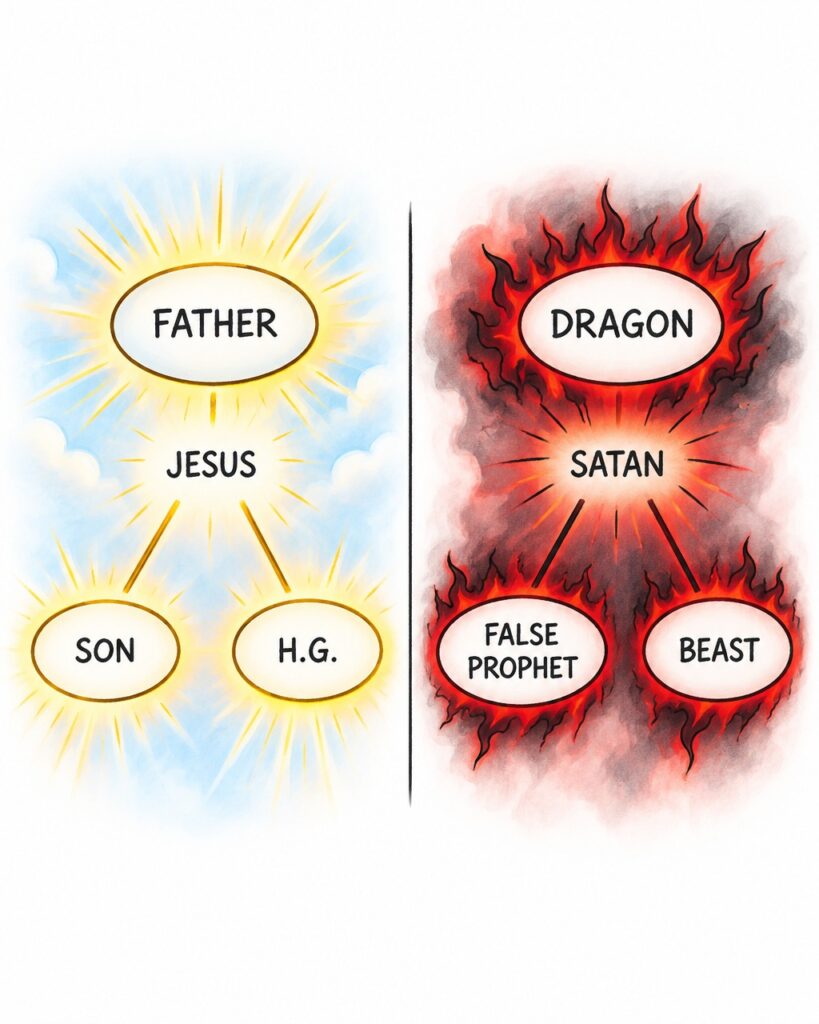
This diagram shows what we call “the trinity of the devil” — the dragon, the beast, and the false prophet. This is Satan’s counterfeit of the true Godhead.
On one side of this second diagram, are three ovals labelled Father, Son, and Holy Ghost, with the name Jesus written between them. We understand that the Father is the Spirit that fills all space and time, invisible; the Son is that same Spirit made flesh — God manifested in a body; and the Holy Ghost is the anointing and power of that Son poured out upon the church, the Holy Ghost is the Same Son in Spirit form upon the church. Although the exact term “Holy Trinity” is never found in Scripture, it has become the common way both Catholic and Protestant churches describe this understanding.
On the other side of the diagram, John’s vision shows a counterfeit trinity — the dragon, the false prophet, and the beast — expressing the very nature of Satan. Just as the Father is the beginning of all things in Christ, the dragon is the symbol of the beginning of all things in the Antichrist. Just as the Son is the Spirit of God made flesh, the false prophet is the spirit of the dragon made flesh — what 2 Thessalonians calls “the man of sin.” And just as the Holy Ghost is the anointing and power of God upon man, the beast is the anointing and power of Satan upon man.
Keep these two diagrams in mind, because they will be used throughout this entire series, especially as we reach the end-time application.
Was the Serpent a Beast?
To begin tracking “the beast,” we must first ask: was the serpent a beast? Was he simply a snake?
Genesis 3:1 (KJV)
Now the serpent was more subtil than any beast of the field which the LORD God had made. And he said unto the woman, Yea, hath God said, Ye shall not eat of every tree of the garden?
Notice that Scripture itself calls the serpent “a beast of the field” — more subtle than the rest. If the writer had simply meant a snake, he could have compared the serpent to any other creeping thing. Instead, he compares him to other beasts of the field. This tells us the serpent belonged, at that time, to the classification of “beast” — and, as we will see, he stood upright.
God’s Classification of Earth’s Creatures
According to the creation account, there are five major categories of earth’s creatures: beasts, cattle, creeping things, birds, and fish.
Genesis 1:24-25 (KJV)
24 And God said, Let the earth bring forth the living creature after his kind, cattle, and creeping thing, and beast of the earth after his kind: and it was so.
25 And God made the beast of the earth after his kind, and cattle after their kind, and every thing that creepeth upon the earth after his kind: and God saw that it was good.
Notice that God clearly separates beast, cattle, and creeping thing — three different categories within the animal kingdom (with birds and fish mentioned elsewhere in Genesis 1). Although today we casually lump all animals together as “beasts,” the Bible does not.
Beasts are mammals — usually hairy, predatory, reproducing through sexual intercourse, and far more intelligent than other creatures. Apes, monkeys, lions, and the big cats fall into this group. They hunt, so they are cunning; some walk on two feet, some climb trees, and they build dens or nests. Because they hunt, their eyes face forward.
Cattle also belong to the wider animal kingdom, but rank lower. They are grazers and foragers, defined by hooves rather than paws or claws. Because they are hunted rather than hunters, their eyes are set on the sides of their heads, giving them almost all-round vision without needing to turn their whole head, unlike predatory beasts, which must turn their heads to see behind them.
Creeping things move low to the ground on short legs — amphibians, reptiles, insects, and small mammals such as weasels and mongoose that dig and live in the ground.
A New Classification After the Fall
By the time we reach Leviticus, after the Exodus, God gives the people of Israel instructions on what creatures are lawful to eat. Leviticus 11 (verses 1-42) actually expands the earlier five categories into six:
- Verses 1-8: beasts and cattle
- Verses 9-12: fish
- Verses 13-19: birds and flying insects
- Verses 20-23: (other) insects, under creeping things
- Verses 29-31: creeping mammals
Leviticus 11:29-31 (KJV)
29 These also shall be unclean unto you among the creeping things that creep upon the earth; the weasel, and the mouse, and the tortoise after his kind,
30 And the ferret, and the chameleon, and the lizard, and the snail, and the mole.
31 These are unclean to you among all that creep: whosoever doth touch them, when they be dead, shall be unclean until the even.
Then comes the sixth and final classification, found in verses 41-42:
Leviticus 11:41-42 (KJV)
41 And every creeping thing that creepeth upon the earth shall be an abomination; it shall not be eaten.
42 Whatsoever goeth upon the belly, and whatsoever goeth upon all four, or whatsoever hath more feet among all creeping things that creep upon the earth, them ye shall not eat; for they are an abomination.
This is the first place Scripture uses the phrase “whatsoever goeth upon the belly.” Notice something important: snakes are never listed under beasts, cattle, or creeping things. They belong to this separate classification — creatures that go upon the belly. After the fall, the serpent’s kind became this new classification. It is important to notice this new character, because God changed the serpent’s form so that his true nature could be identified — since he is dangerously subtle.
Going on the belly is regarded as one of the most unsettling traits in the whole animal kingdom. People may have all sorts of fears — spiders, ants, mice, lizards, frogs — but there is hardly a person on earth who is not unsettled by the presence of a snake, however harmless it may be. Only those who take time to study snakes learn not to fear or kill them on sight. This instinctive human reaction to a creature that moves on its belly has been studied for a long time, and it points to something deeper about the serpent’s changed, hidden character.
The Serpent Before the Curse — An Upright Beast
Before the fall, the serpent was not classified with the creatures that go on their bellies — he was classified as a beast, and not even as low as cattle. We know this because of the curse itself:
Genesis 3:14 (KJV)
And the LORD God said unto the serpent, Because thou hast done this, thou art cursed above all cattle, and above every beast of the field; upon thy belly shalt thou go, and dust shalt thou eat all the days of thy life.

If the serpent already went upon his belly before the fall, then this statement would not be a curse at all — it would simply describe what he already was. This scripture alone proves that before the curse, the serpent did not go on his belly. He was, in fact, cursed above all cattle and above every beast of the field — meaning of every creature in those categories, God changed him the most.
Other creatures may have adapted or changed somewhat because of the fall of man, even growing more aggressive over time. But no creature was changed as completely as the serpent. In Genesis 1 he is classified as a beast. By Genesis 3:14 he has fallen into a brand-new classification — one that goes on the belly. He lost his form, his shape, his classification, his ability to communicate, his intelligence, and every ability that beasts of the field possess, including sound, speech, and hearing. Even his eyes changed — no longer forward-facing like a hunter’s, but set to the side, like a hunted creature. God did not simply bend or punish the serpent’s existing shape; He completely transformed him and hid his previous identity. This may even explain why scientists have long searched, without success, for what they call the “missing link” — because the original beast’s form no longer exists to be found.
Because his form was totally changed, the trail of the original serpent is very hard to track from the beginning — one can now only follow the creature he became after the curse. This is why, throughout the Old and New Testaments, the true identity of “the serpent” tends to stay hidden, and can only be understood by someone who knows the nature of the one who was there in the beginning. That is much like why so few people understand the real mark of the beast today.
The serpent was not yet a reptile before the fall— the curse made him a reptile. Before that, he was just like a man; he walked upright, was with the woman, and through that union Cain was born, carrying the nature of his father. This beast walked upright like a man.
The serpent was first a beast — and an upright one. He was not a scaly, cold-blooded reptile walking on legs, like the dragons pictured in Chinese art, and he was not a dinosaur either. A reptile is a reptile; that is its own classification. The serpent, before the curse, belonged to the classification of beast — meaning he had to have been warm-blooded, covered in hair, and resembling a human in form. When God cursed and struck him, He changed his image from beast to creeping thing — and changing his image meant changing his entire character. That change exposed what had secretly been his true inner nature all along: though he appeared an upright beast, he carried the character of something that creeps.
This is much like how, today, when a woman describes a man as “creepy,” she is identifying a character trait — someone who moves in a deceptive, deceitful, and unsettling way. It usually shows on her face as distrust, disgust, or fear — an instinctive warning sign. This same hidden character was what became visible in the serpent once he was cursed to creep.
Man, Too, Is Called a Beast
Before the fall, the serpent was like a beast resembling a man, only far more hairy. Interestingly, man himself falls under the classification of “beast” after the fall, because — apart from the Holy Ghost — man is described in Scripture the same way. Consider:
Ecclesiastes 3:18-20 (KJV)
18 I said in mine heart concerning the estate of the sons of men, that God might manifest them, and that they might see that they themselves are beasts.
19 For that which befalleth the sons of men befalleth beasts; even one thing befalleth them: as the one dieth, so dieth the other; yea, they have all one breath; so that a man hath no preeminence above a beast: for all is vanity.
20 All go unto one place; all are of the dust, and all turn to dust again.
Solomon is teaching that, apart from God, man is really no different from a beast: both breathe air, both die the same way, both return to dust. Any sense of superiority, without God, is simply vanity. However, before the fall, man was not in the beast classification at all. He was the very last and highest classification created — a son of God, set to have dominion over the animal kingdom, not a member of it. Only after he lost his glory (his theophany) was he reduced to the classification of beast, just as Ecclesiastes 3:20 confirms: all return to dust.
For the serpent’s seed to be passed on through mankind, the serpent had to be made in a form close enough to the human structure — and Satan knew this, and used it.
Satan Used the Serpent — The Serpent Was Not the Enemy
Here is a very important observation: the serpent was not the enemy — Satan was. Satan simply used the serpent for his own purposes; the serpent only became “the enemy” once Satan possessed him. This same pattern will repeat at the end time. People often expect the beast of the end time to be someone who is obviously wicked, an outright enemy like a tyrant or dictator. But the beast at the end, like the serpent in the beginning, may appear harmless — until it is taken over by the same spirit that possessed the serpent.
In the garden of Eden, something happened that caused the serpent to be possessed by a nature to seduce and mislead the woman.
What Does “Subtle” Mean?
The Bible says the serpent was “more subtle” than any other beast. This means he was more intelligent, cunning, and interesting than every other creature. Subtlety belongs only to beasts, not to lower creatures. A pig, for example, is not subtle — it stumbles about, driven by hunger, easily startled, and clumsy. But watch a leopard move at night, or lions hunting together in the grass — planning, patience, and cunning: that is subtlety.
Insects show only adaptation, not intelligence — camouflage is a bodily condition, not a plan. But higher beasts, such as chimpanzees, gorillas, and orangutans, show real intelligence: picking up an object carefully, inspecting it, turning it over. The higher the creature in this classification, the greater the cunning, thinking ability, and capacity to survive.
The serpent stood above even these — subtle enough that Satan only needed one thing: to cause this creature to form a close affinity, a friendship, with the woman. No other beast on earth — not even the most intelligent ape — can form the kind of deep mutual understanding that existed between the serpent and Eve. This was not simple demon possession, where the enemy merely spoke through the creature as with modern cases of casting out demons. No, no, no. This was something far more real. The serpent was given the ability to become the woman’s equal — her friend.
Adam and Eve should have known they were the highest classification of all creation, yet this creature was able to convince the woman that he stood on equal ground with her. That same tactic is still used today. A man wishing to seduce a woman rarely presents himself as an obvious threat — he simply becomes her friend first. That is how it begins, and it has never changed. In the same way, if we are looking for the mark of the beast in the end time, we should not expect someone who is openly our enemy, like a Saddam Hussein or an Adolf Hitler. It comes disguised as a friend.
The Trail of the Serpent
Brother Branham himself planned to preach a message called The Trail of the Serpent. In The Power of Transformation, preached 31st October 1965, paragraph 136, he said that when he went home that time, he intended to preach on the subject: “The beast at the beginning, the beast at the end, trail him right through the Bible and show how he heads up” — meaning, how he is finally revealed at the end.
That is exactly the purpose of this series: to study the beast at the beginning, trail him all through Scripture, and then see how he is manifested at the end time, eventually reaching the true understanding of the mark of the beast.
Just weeks before his death, in Trying to Do God a Service, preached 27th November 1965, paragraph 87, the prophet said he planned to preach a message about four hours long titled “the beast at the beginning and the beast at the end through the trail of the serpent.” He said he had his scriptures ready — the beast from the beginning, the beast in the Garden of Eden, the same beast at the end — a religious person, and a denomination, tracing that trail right through Scripture. He said the Holy Spirit had only just shown this to him shortly before. Sadly, he never lived to preach that particular message.
Brother Branham was known as a skilled and dedicated hunter, and this may well be part of why he was inspired to teach in this “trailing” way. Although he did not preach this specific subject before he died, that does not stop believers today from searching out the revelation God gave him — especially since, if all mysteries were to be revealed through the ministry of the seventh messenger, it is reasonable to believe he mysteriously wove this teaching through the rest of his ministry, and it is left for us to search it out.
What Does It Mean to “Trail” or “Track” Something?
American Indians and cowboys used to say that a good tracker could track a serpent across a rock. It is easy to see a snake’s trail across sand, since his belly disturbs the surface, but tracking him across solid rock is far harder — you must notice small scratch marks instead.
To track means to follow the signs left behind by a creature as it moves from where it started to where it is going — footprints, droppings, disturbed ground, fur, or feeding marks. Even someone who has never seen the creature before can learn a great deal about its character, habits, weight, and diet simply by carefully following its trail before ever laying eyes on it.
This is exactly why we must track the serpent: since the beast already lives among us today, and we do not immediately recognise him, we must go back to the very beginning to identify the beast there, then trail him right through Scripture, learning his character along the way — so that we are able to recognise him in our own day.
How the Trail of the Serpent Connects to the Mark of the Beast
The mark of the beast described in Revelation 13 is placed upon men. That fact alone should raise a question: how can the mark of a beast be placed on men, unless men and this beast share some connection? Shouldn’t a beast’s mark be placed on other beasts instead?
The very first man to receive such a mark was Cain, son of the serpent — and that is where this trail truly begins.
Returning to our opening scripture:
Revelation 13:16-18 (KJV)
16 And he causeth all, both small and great, rich and poor, free and bond, to receive a mark in their right hand, or in their foreheads:
17 And that no man might buy or sell, save he that had the mark, or the name of the beast, or the number of his name.
18 Here is wisdom. Let him that hath understanding count the number of the beast: for it is the number of a man; and his number is Six hundred threescore and six.
Notice the common mistake many people make: the mark of the beast is not simply “666.” Six hundred threescore and six is the number of his name — a separate thing. The mark is one thing, the name is another, and the number of the name is yet another. All three, however, belong to this same beast, and if we can successfully trail that beast through Scripture, we will come to understand him fully.
Closing Thoughts
And so we begin the trail, saints of God. This has only been the introduction to the series, laying the foundation of what a beast is, what a man is, and how the serpent’s true nature and classification were changed at the fall. You are encouraged to search the Scriptures, the writings of the message, and the Word of God further on your own as homework. May the Lord bless you until we continue this study of the mark of the beast.