
Introduction: A Misunderstood Throne
Most people — Christians and non-Christians alike — have a mental image of God sitting on a grand, luminous chair in the heavens, reigning over the universe from above. This image, shaped by centuries of religious art and popular imagination, has made the mystery of God increasingly unfathomable. But here is a truth that may challenge everything you thought you knew: this conception of God’s throne has never been accurate. God has never been an old man sitting on a throne somewhere in the skies as we usually represent it.
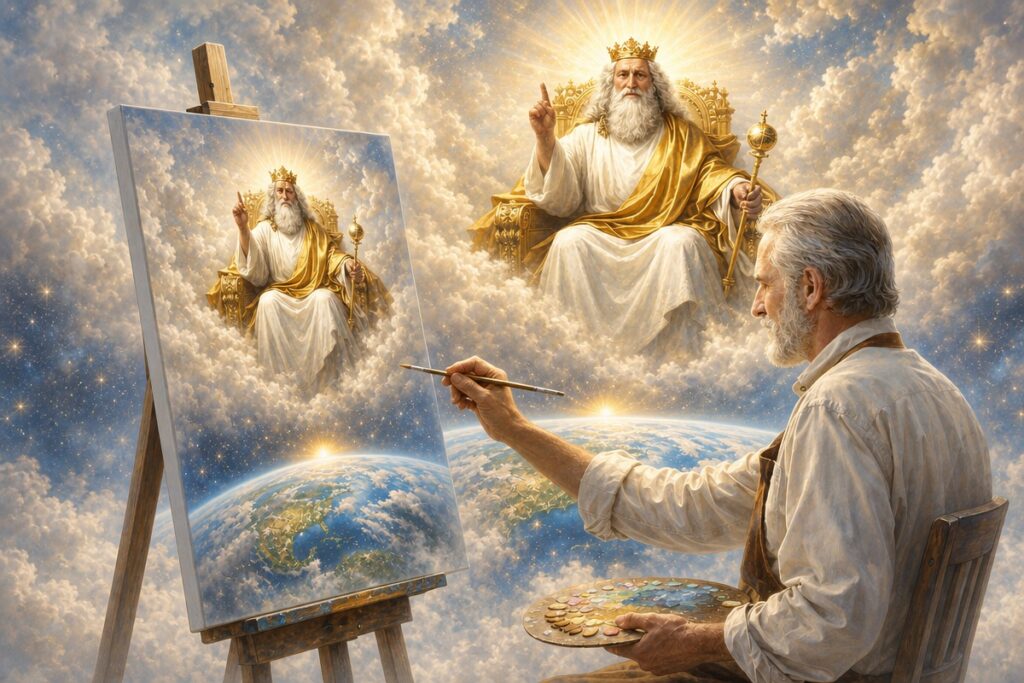
The opening verse of our study sets the tone beautifully. In Hebrews 12:2, the Bible says:
“Looking to Jesus, the founder and perfecter of our faith, who for the joy that was set before him endured the cross, despising the shame, and is seated at the right hand of the throne of God.”
We do not deny that God has a throne. He does. We do not deny that He desires to reign over His people. He does. But not in the way we imagine — not the way a carnal man rules over earthly kingdoms.
To truly understand the throne of God, we must trace it through Scripture. We must ask: did God actually need a physical place to reign? And if so, where has that place been throughout history?
Notice something remarkable: from Adam to Abraham, Isaac, and Jacob, there is no mention of a specific place from which God reigned — no visible throne, no designated location. It was only when Moses stepped onto the scene, after leading the children of Israel out of Egypt, that we begin to hear of a place where God would reign. That is where our study begins.
Part One: The Tabernacle, a Prophet, and a Priesthood
God Commands a Meeting Place
When the children of Israel were wandering in the desert, God gave Moses precise instructions for building a Tabernacle — a sacred structure that would serve as God’s throne among His people. Three key scriptures establish this:
“Exodus 25:22 — And there I will meet with thee, and I will commune with thee from above the mercy seat, from between the two cherubims which are upon the ark of the testimony, of all things which I will give thee in commandment unto the children of Israel.”
“Exodus 29:43 — And there I will meet with the children of Israel, and the tabernacle shall be sanctified by my glory.”
“Exodus 26:30 — And thou shalt rear up the tabernacle according to the fashion thereof which was shewed thee in the mount.”
God gave Moses a heavenly blueprint — a vision of exactly what the Tabernacle should look like. This shows how profoundly important the configuration of this dwelling was to God.
The Layout of the Tabernacle
The Tabernacle had three distinct sections:
1. The Outer Court — containing two objects: a bronze altar for burnt sacrifices, and a bronze laver (basin) filled with sanctified water, where the priests washed their hands and feet before entering.
2. The Inner Court (Holy Place) — containing three objects: the golden lampstand (menorah) with seven branches on the left, the table of showbread (twelve loaves) on the right, and the altar of incense just before the veil.
3. The Most Holy Place (Holy of Holies) — separated from the Holy Place by a thick veil of badger skins, so heavy in Solomon’s Temple that it required teams of oxen to pull. Inside were two sacred objects: the Ark of the Covenant — a wooden box overlaid with gold, containing the Ten Commandments — and above it, the mercy seat, made of gold and flanked by cherubim whose wings covered the seat and whose faces looked toward one another.
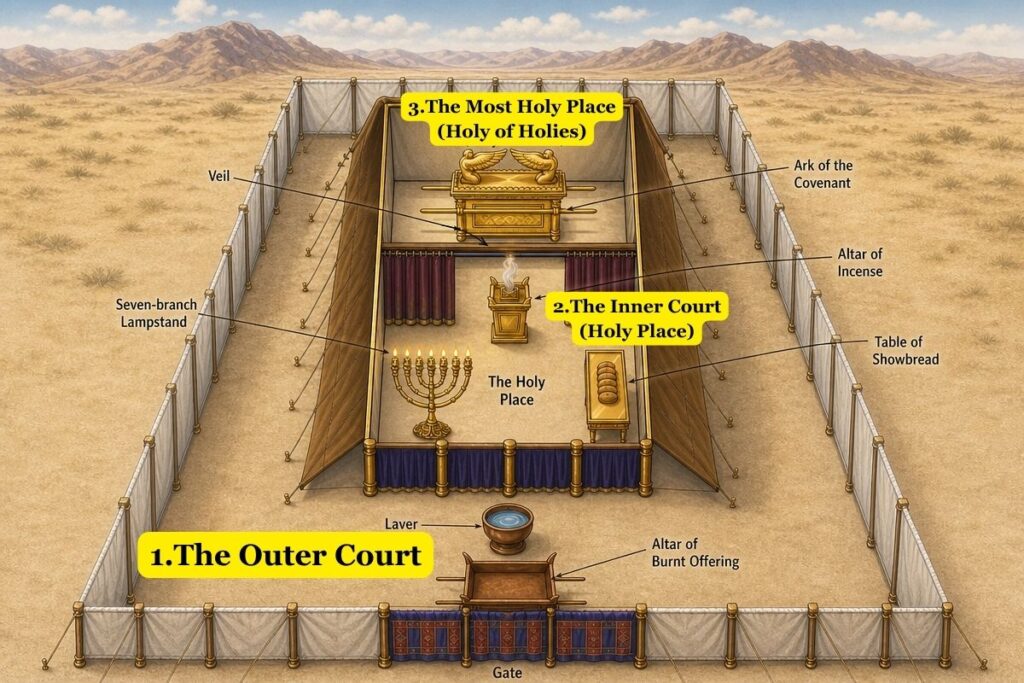
Once Moses completed the Tabernacle, the children of Israel were commanded to worship God only in this place, wherever they traveled. The Tabernacle was the throne of God in the desert.
The Godhead of the Desert Tabernacle
In the desert, God had five elements through which He revealed Himself to His people:
- The pillar of fire
- The pillar of cloud
- Moses (the prophet)
- Aaron (the high priest)
- The priesthood
These five elements brought the Tabernacle — an immobile, fixed structure — to life. Without them, it was simply wood, fabric, and metal. Together, they constituted what the Bible and this study call the Godhead.
What Does “Godhead” Actually Mean?
Most people assume “Godhead” simply refers to the Father, the Son, and the Holy Spirit — a matter of trinitarianism versus unitarianism. But the word carries a far deeper and more practical meaning.
The original English word for “Godhead” was “Godhood.” To understand it, consider two familiar words:
- Brotherhood — not a single brother, but many brothers forming a unity. You need multiple elements to form a brotherhood.
- Neighborhood — not a single house, but many houses and families forming a community. One house alone is not a neighbourhood.
Likewise, Godhood refers to the combination of elements that constitute God’s revelation for a given era. It describes the various ways in which God chooses to make Himself known to His people at any particular time.
Over time, translators shifted the word to “Godhead”. But the true definition remains this:
Godhead means the combination of elements through which God reveals Himself — the things that make God known.
In the desert, the Godhead of God consisted of the pillar of fire, the pillar of cloud, Moses, Aaron, and the priesthood. These were God’s chosen means of making Himself known to His people.
Part Two: The Tabernacle at Shiloh — A High Priest and a Priesthood
God Chooses a Permanent Location
When the children of Israel crossed the Jordan River into the Promised Land, Moses was no longer with them. God had promised to establish a permanent dwelling place for His name. As written in Deuteronomy 12:10–14:
“But when ye go over Jordan, and dwell in the land which the LORD your God giveth you to inherit, and when he giveth you rest from all your enemies round about, so that ye dwell in safety; Then there shall be a place which the LORD your God shall choose to cause his name to dwell there; thither shall ye bring all that I command you; your burnt offerings, and your sacrifices, your tithes, and the heave offering of your hand, and all your choice vows which ye vow unto the LORD: And ye shall rejoice before the LORD your God, ye, and your sons, and your daughters, and your menservants, and your maidservants, and the Levite that is within your gates; forasmuch as he hath no part nor inheritance with you. Take heed to thyself that thou offer not thy burnt offerings in every place that thou seest: But in the place which the LORD shall choose in one of thy tribes, there thou shalt offer thy burnt offerings, and there thou shalt do all that I command thee.”
The Tabernacle was established at Shiloh — the place God chose to make His name dwell among His people in the Promised Land. Notice the shift in the Godhead:
- In the desert: a Tabernacle, a prophet (Moses), and a priesthood
- In the Promised Land: a Tabernacle, a high priest, and a priesthood — but no more prophet
This continued until the high priest Eli corrupted the priesthood. His sons defiled the Tabernacle and its sacred rites. It was then that God called a new and significant prophet — Samuel — to restore order and establish a new Godhead. Samuel ultimately anointed David as king, and the movement toward a more permanent throne began.
The Godhead had changed, but the Tabernacle remained. God’s manner of revealing Himself had evolved, yet His purpose remained the same.
Part Three: The Temple, a City, a King, Prophets, and a Priesthood
Solomon Builds God’s House in Jerusalem
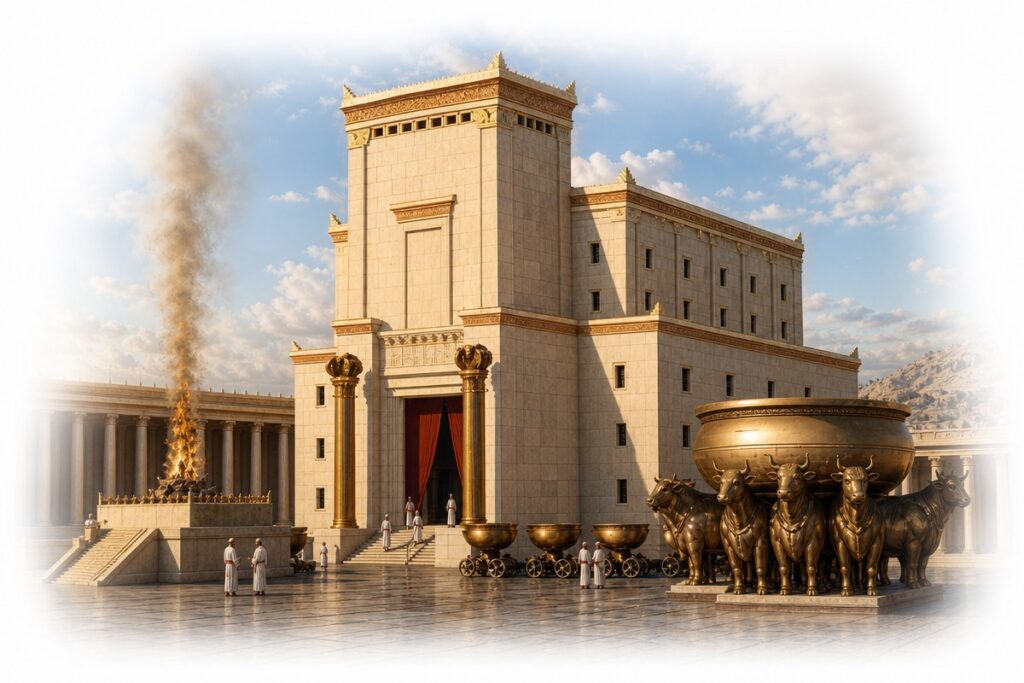
David longed to build a permanent temple for God. Though God prevented David from building it, He permitted David’s son Solomon to build it in Jerusalem. This marks a profound shift in the nature of God’s throne. As recorded in 2 Chronicles 6:1–11:
“Then said Solomon, The LORD hath said that he would dwell in the thick darkness. But I have built an house of habitation for thee, and a place for thy dwelling for ever. And the king turned his face, and blessed the whole congregation of Israel: and all the congregation of Israel stood. And he said, Blessed be the LORD God of Israel, who hath with his hands fulfilled that which he spake with his mouth to my father David, saying, Since the day that I brought forth my people out of the land of Egypt I chose no city among all the tribes of Israel to build an house in, that my name might be there; neither chose I any man to be a ruler over my people Israel: But I have chosen Jerusalem, that my name might be there; and have chosen David to be over my people Israel. Now it was in the heart of David my father to build an house for the name of the LORD God of Israel. But the LORD said to David my father, Forasmuch as it was in thine heart to build an house for my name, thou didst well in that it was in thine heart: Notwithstanding thou shalt not build the house; but thy son which shall come forth out of thy loins, he shall build the house for my name. The LORD therefore hath performed his word that he hath spoken: for I am risen up in the room of David my father, and am set on the throne of Israel, as the LORD promised, and have built the house for the name of the LORD God of Israel. And in it have I put the ark, wherein is the covenant of the LORD, that he made with the children of Israel.”
What does it mean that God dwells in “thick darkness”? It does not mean darkness in a sinister sense. It means God dwells in a place unknown, unrevealed — too mysterious to be fully known. Yet in choosing Jerusalem and the lineage of David, God was making Himself known through a new configuration.
God Sanctifies the Temple and the City
God’s response to Solomon’s prayer confirmed His approval of the new throne in 1 Kings 9:3:
“I have hallowed this house, which thou hast built, to put my name there for ever; and mine eyes and mine heart shall be there perpetually.”
The word “hallowed” means God declared the temple holy — set apart, approved, and reserved exclusively for His use. The phrase “forever” here does not mean for eternity, but rather for a very long period — as long as God’s purposes required it.
God also sanctified Jerusalem as the holy city, so that all faithful Israelites were to make pilgrimages there for worship and sacrifice. As He declared in 1 Kings 11:36:
“And unto his son will I give one tribe, that David my servant may have a light alway before me in Jerusalem, the city which I have chosen me to put my name there.”
This is why Jerusalem has been contested for centuries — by Jews, Christians, and Muslims alike. Men have fought, invaded, and burned the city again and again because God had declared it the place of the one true God’s name.
The Godhead of the Temple Era
The Godhead now consisted of:
- The Kingdom of Judah (the line of David)
- The Priesthood
- The Minor Prophets who guided the Davidic lineage
This was reflected even in the access granted: David himself entered the Tabernacle and ate the showbread — something no son of Judah had been permitted before. The configuration of the throne had shifted significantly.
The Corruption and Fall of the Temple
As the generations passed, the kings of Judah became increasingly wicked. Even the high priests turned corrupt. The prophet Abiathar conspired against David, seeking to make Adonijah king instead of Solomon. The priests, kings, and prophets — one by one — compromised the holiness of the city and temple.
And so God allowed Jerusalem and the Temple to fall into the hands of men. A corrupted Godhead could not remain God’s throne. As God promised even to the exiles in Babylon, through Nehemiah 1:9:
“But if ye turn unto me, and keep my commandments, and do them; though there were of you cast out unto the uttermost part of the heaven, yet will I gather them from thence, and will bring them unto the place that I have chosen to set my name there.”
God promised to gather His people to where His name was. And His name — in every era — is not merely a title. It is the living revelation of who God is for that day.
What Is God’s Name?
God’s name is not simply “Jehovah,” “Jesus,” “Elohim,” or “El Shaddai.” These are significant words, each with deep meaning:
- Jehovah — God dwelling among His people
- El Shaddai — the Nourisher, or Almighty God
- Elohim — a Canaanite plural word meaning “gods,” later adopted by Abraham and the Israelites
But God does not need one name alone. When He spoke to Moses at the burning bush, He did not say, “My name is Elohim.” He said, “I AM THAT I AM.”
When God says “the place where I choose to put My name,” He means: the place from which He chooses to reveal Himself. His name is His revelation — the knowledge of who He is for the people of that era.
“A throne, therefore, is a place where the name of God can be identified — where the revelation of who God is can be seen, understood, and known for that day.“
The Temple of Solomon stood as that throne — until its Godhead was corrupted. Then God moved His name elsewhere.
Part Four: A Man — The Ultimate Throne
God Chooses to Dwell in a Human Being
When the kings failed, when Jerusalem was captured and taken into captivity, when the Temple was desecrated by a corrupt and divided clergy — God placed His name in a Man.
In John 5:43, Jesus declares:
“I am come in my Father’s name, and ye receive me not: if another shall come in his own name, him ye will receive.”
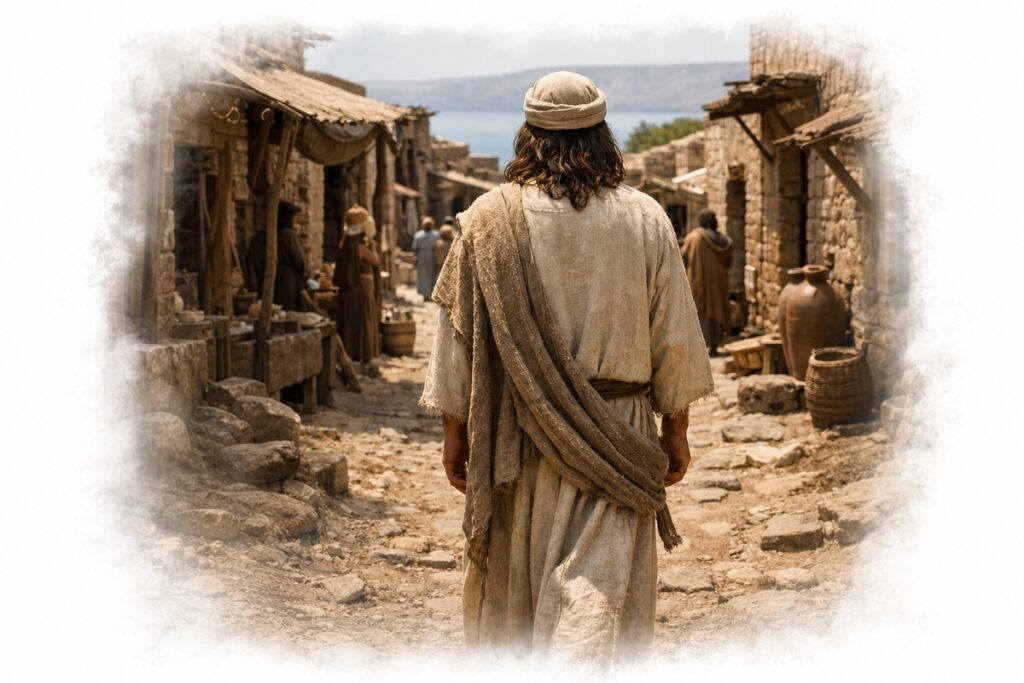
What did Jesus mean by “coming in the name of the Father”? God chose to place His name — His revelation, His identity — in a man named Jesus Christ. The entire New Testament, through the example of Christ, shows us that a man can be the temple and tabernacle of God, and that the Godhead can be revealed through such a man.
Consider these Scriptures:
John 1:29:
“The next day John seeth Jesus coming unto him, and saith, Behold the Lamb of God, which taketh away the sin of the world!”
Matthew 3:17:
“And lo a voice from heaven, saying, This is my beloved Son, in whom I am well pleased.”
Colossians 2:9:
“For in him dwelleth all the fulness of the Godhead bodily.”
In John 1:29, John the Baptist publicly identifies the new tabernacle — the vessel — saying: “Behold the Lamb of God.” This was a public announcement about the tabernacle.
In Matthew 3:17, a voice from heaven publicly identifies where God has chosen to place His name: “This is my beloved Son.” In other words: this is the place I have chosen.
And Colossians 2:9 confirms that the Lamb of God, identified by John, was the very dwelling place of God Himself — the fullness of the Godhead in bodily form.
The Godhead in Christ
What, then, was the Godhead within this new tabernacle — Jesus Christ? Yes, He was simultaneously:
- The Tabernacle
- Son of Man — meaning He was a Prophet
- Son of God — meaning He was a Priest
- Son of David — meaning He was a King
In one tabernacle, you had a prophet, a priest, and a king — mirroring the pattern of the Old Testament temples and Godheads, but now perfectly fulfilled in one man. This is the Order of Melchizedek: the fullness of the Godhead dwelling in the Son.
Christ came to establish a new throne of God — not in a building, not in a city, but in man. He declared that He came to produce many sons like Himself, many brothers bearing His likeness. He founded the Church and commissioned it to build this new temple and new Godhead.
Part Five: The Throne Within — God Reigning in the Heart of the Believer
Man as a Tabernacle
Just as the Tabernacle of Moses had three sections, so too does man:
- The Outer Court — the body
- The Inner Court (Holy Place) — the spirit
- The Most Holy Place — the soul (heart), the center where the Ark was kept
And it is in the center — in the heart — that God comes to establish His throne.

“Where Two or Three Are Gathered in My Name”
Matthew 18:20 is often misunderstood:
“For where two or three are gathered together in my name, there am I in the midst of them.”
Many use this to mean simply gathering together and repeating the name of Jesus. But the true meaning is far deeper.
“Gathered in my name” means gathered in the same revelation — united under the same understanding of who God is.
“I am there among them” means God approves what they approve — He endorses the decisions made in the light of His revelation.
The context in Matthew 18 is the discipline of a wayward brother: speaking to him privately, then with witnesses, then before the church. Only when those present share the same revelation of God — when they are truly part of what God has sanctified — can they bind and loose on earth what is bound and loosed in heaven.
This is not a formula. It is a condition of the heart and of revelation.
Consider this sobering truth: countless churches in this world claim to be gathered in the name of Jesus — some with thousands of members. Yet God is not among them. Why? Because they do not form His Godhead. They have gathered under the banner of Christianity, but Christ is not present to approve their decisions. They cannot speak for the Kingdom of God because God has not sanctified their assembly.
The Eternal Purpose: You Are the Throne
The First Throne Was Adam
Here is perhaps the most powerful truth in this entire study:
There has never been a physical throne in the universe where God sits and presides over all things. The first throne God ever created was Adam — man himself.
God’s purpose from the very beginning was to dwell in man — to live and reign from within the heart of the believer. The Garden of Eden required no visible throne, no elaborate ceremony. Adam needed nothing special to speak with God. God was not separate from His son.
But that throne was defiled in Eden. And from that moment, God separated Himself from the throne He had created on earth. He had to bring the desert Tabernacle through Moses just to begin the long journey back to that original throne.
Every Tabernacle, every Temple, every priesthood — they were all temporary expressions of what God ultimately intended: to dwell in the heart of man.
As Acts 7:44–51 declares — spoken by Stephen, the disciple of Christ, moments before he was stoned to death:
“Our fathers had the tabernacle of witness in the wilderness, as he had appointed, speaking unto Moses, that he should make it according to the fashion that he had seen. Which also our fathers that came after brought in with Jesus (Joshua) into the possession of the Gentiles, whom God drave out before the face of our fathers, unto the days of David; Who found favour before God, and desired to find a tabernacle for the God of Jacob. But Solomon built him an house. Howbeit the most High dwelleth not in temples made with hands; as saith the prophet, Heaven is my throne, and earth is my footstool: what house will ye build me? saith the Lord: or what is the place of my rest? Hath not my hand made all these things?”
Stephen’s words are clear: no earthly building is worthy of God or large enough to contain Him. Everything humans create for God was, in fact, created by Him. The Tabernacle and Temple were temporary — scaffolding pointing toward something far greater.
Stephen then rebukes those who could not understand, calling them “stiff-necked” and “uncircumcised in heart and ears” — people who kept trying to confine God to natural structures while resisting the Holy Spirit.
Becoming Ready as the Throne of God
Just as every throne in history took years to prepare — the Tabernacle required detailed construction; the Temple took years to build; and the Lord Jesus Christ Himself spent 30 years before the Name of God was openly seen in Him — so too does the believer require time to be sanctified and made ready.
To become the throne of God, we must study His other thrones. We must examine the heavenly throne, the earthly tabernacles, and the furnishings within them — and align them with our own body, spirit, and soul — to understand how our inner man must be built according to God’s specifications.
The goal is this: a believer who surrenders his body as a temple, a throne, to be used for God’s divine purpose. A believer in whom the Godhead fully dwells — revealing God’s nature, God’s purpose, God’s reputation for this age.
This is the reason for everything:
- God created us for this.
- He called us for this.
- He sanctified us for this.
- He justified us for this.
- He filled us with the Holy Spirit for this.
Everything concurs toward one goal: that we become the throne of God.
Conclusion: Do Not Be Stiff-Necked
As we close this first part of our study, let us not be like those to whom Stephen spoke — hardened and proud, resisting the Holy Spirit in our desire to keep God confined to natural, man-made structures.
Let us not be uncircumcised in heart — lawless on the inside, refusing the Spirit’s work.
Instead, let us allow the Holy Spirit to help us build a spiritual house — a holy, incorruptible, and eternal priesthood.
This is God’s prophecy. This is His purpose. This is why He created us, called us, sanctified us, and filled us. He wants us to be His throne.
In the sessions ahead, we will study the Tabernacle of Moses in detail, the heavenly throne as seen in the visions of Isaiah and John, and all the furnishings of the temples and tabernacles — placing them in parallel with the body, spirit, and soul of the believer. We will explore what it means for the Divinity to dwell within us and make us a fully functional throne of God.
Until then: may the Lord be with you, and may He bless you.